
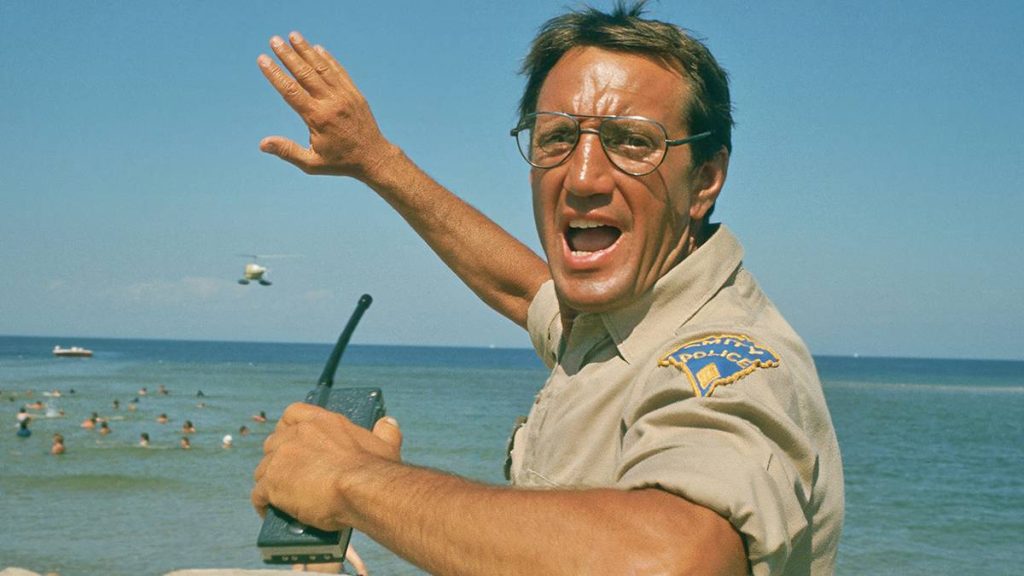
What do you get when you cross Steven Spielberg, Roy Scheider, and water? Okay, but how about if there’s no shark, but a dolphin instead? 18 years after Jaws, Spielberg and Scheider went back into the water for seaQuest DSV, a three-season sci-fi series set under the sea in the near future (well, past, as the storyline begins in 2018). After mankind has used up all natural resources above ground, humans are forced to live in colonies on the ocean floor. However, the only thing choppier than the seas above was seaQuest DSV‘s production history, which scuttled this show partway through its third season.
‘seaQuest DSV’ Sails Troubled Waters Behind the Scenes in Season 1

The series follows the crew of the high-tech submarine seaQuest DSV 4600, led by Captain Nathan Bridger (Roy Scheider), who designed the ship and is called out of retirement to take command of it. Bridger and company fall under the authority of the United Earth Oceans Organization, also known as UEO, a United Nations-type coalition of surface countries and undersea confederations. The crew (at least in the first season) consists of Dr. Kristin Westphalen (Stephanie Beacham), oceanographer and Chief Medical Officer; teen prodigy Lucas Wolenczak (Jonathan Brandis), part of the scientific group aboard (thanks to some pulled strings from Papa Wolenczak, one of the world’s most esteemed scientists; Chief Engineer Katherine Hitchcock (Stacy Haiduk); supply and morale officer Lieutenant Benjamin Krieg (John D’Aquino); communications officer Lieutenant JG Tim O’Neill (Ted Raimi); and Darwin (Frank Welker), a dolphin who talks to the crew thanks to technology developed by wunderkind Wolenczak; and a host of others. Their mission is simple: protect seafloor colonies from hostile, nonaligned nations, perform undersea research, and mediate disputes, with the latter being something seaQuest DSV could have used off-screen.
Writer Rockne S. O’Bannon came up with the idea for seaQuest DSV, one of a number of similar shows to rise up after the success of Star Trek: The Next Generation (and one of the more blatant: Wolenczak is Wesley Crusher, Westphalen akin to Beverly Crusher, Darwin as Data, etc.). But it caught the attention of Steven Spielberg, who came on as executive producer and quickly brought on Robert Ballard as technical advisor. Spielberg’s involvement came some serious coin, with NBC paying Universal Television and Amblin Entertainment $1 million an episode for 22 episodes, almost double the industry standard for a brand-new show at the time. That kind of money doesn’t come without a price, however, and the network insisted on making every decision about the show significantly more difficult to make as a result.
It didn’t help that, when production began, Spielberg was off in Poland filming Schindler’s List, and while there, he was also working on finalizing special effects on a quiet little movie called Jurassic Park. As a result, he didn’t really have much time for seaQuest DSV, and with no hands-on guidance on the series’ production in Los Angeles, things got troublesome. Scheider had a heated argument with executive producer and showrunner Tommy Thompson over the creative vision for the show. Scheider wanted what he signed up for, a quirky but more realistic show, one based on plausible oceanographic research and relationships, which was largely the direction for that first season. Thompson wanted a darker, more action-based show. Things got so heated that Spielberg had to call L.A. from Poland to shut down filming following the filming of Episode 3 (per Los Angeles Times). David J. Burke, a new executive producer, came in to smooth things over, and gave Spielberg and Scheider his word that he would stick to their vision for an optimistic, inspiring, and science-focused series.
Season 2 of ‘seaQuest DSV’ Ditches Cast, Science Fact for “Eye Candy”
With the animosities between Scheider and Thompson smoothed over, for the time being, seaQuest DSV had smooth sailing from that point on, right? Absolutely not. Critics savaged the show, calling the grounded sci-fi show “ponderous” and “plodding.” Viewers seemingly agreed, with the huge audience that tuned in to the series premiere largely abandoning the series as the first season went on, resulting in seaQuest DSV finishing 83rd out of 132 prime-time network series in 1993. The series had already started a course-correct toward the end of the season, stepping away from the plausible to the fantastical, with more outlandish sci-fi concepts, including aliens, even relieving Ballard of his technical advisor post (you don’t need science fact if you’re not going to use it).
So Season 2 went all in, replacing four of the nine headlining cast members, including Beacham, with younger actors, moved production from Los Angeles to Orlando, re-designed the bridge of the ship to be less technically accurate but more cinematic (less The Hunt for Red October, more Star Trek), and ditched science fact for a heavier focus on fantasy and sci-fi, like genetically engineered people that could breathe underwater and a giant crocodile, indicative of their “monster of the week” episodes (per Los Angeles Times). It was — for all intents and purposes — a completely different show. Scheider, for one, was less than impressed with the changes, calling the second season “childish trash.” He decried the network’s micromanagement of the series, particularly the decision to place emphasis on the gadgetry, big action, and women in sexy scenes, calling it “eye candy.”
Steven Spielberg and Roy Scheider Jumped Ship for Season 3 of ‘seaQuest DSV’

The fact that seaQuest DSV was renewed at all puzzled many Hollywood executives, who largely saw its first season as an abysmal failure, calling the attempts at overhauling the show “mystifying” and “bafflingly unprofessional.” One former network executive, per Los Angeles Times, even claimed that seaQuest DSV, with its critical ravaging, lack of execution, and terrible ratings, could only have been renewed because NBC wanted to “maintain a relationship with Steven Spielberg.”
None of this helped, with Giant Freakin’ Robot calling Season 2 “flaming ratings death.” But NBC wouldn’t give up on it, instead re-hauling it yet again for a third season. This time, there would be no Scheider, as he jumped ship (literally). This brought seaQuest back to Earth with a more traditional science fiction focus. It was a different show yet again, now set in 2032 (and garnering a name change to seaQuest 2032 for its final season) and moving on from Spielberg’s involvement, with his name removed from the opening credits. And to give the series a grittier edge, they brought in veteran actor Michael Ironside as stern, militaristic Captain Oliver Hudson, with Ironside explaining that, “You won’t see me fighting any man-eating glowworms, rubber plants, 40-foot crocodiles, and I don’t talk to Darwin.” That, too, didn’t help seaQuest 2032 with ratings, and, after only 13 episodes, NBC finally pulled the plug on the series. SeaQuest DSV ultimately didn’t know what it wanted to be, or, more truthfully, knew exactly what it wanted to be, but network executives “knew better.” It exists as a series with a first season that proved it could have been groundbreaking, only to be followed by two more seasons that proved it could be forgotten.

- Release Date
-
1993 – 1996-00-00
- Directors
-
Bryan Spicer, Anson Williams, Les Sheldon, Jesús Salvador Treviño, Oscar L. Costo, Bill L. Norton, Bruce Seth Green, John T. Kretchmer, Steven Robman, Steve Dubin, Jonathan Sanger, Robert Wiemer, Gabrielle Beaumont, Helaine Head, Burt Brinckerhoff, James A. Contner, Joe Napolitano, Irvin Kershner, Gus Trikonis, Lindsley Parsons III, Steve Beers, Casey O. Rohrs, Les Landau
- Writers
-
Patrick Hasburgh, Carleton Eastlake, David Kemper, Clifton Campbell, Lawrence Hertzog, Robert Engels, William Rabkin, John J. Sakmar, Hans Tobeason, Javier Grillo-Marxuach, Kerry Lenhart, Lee Goldberg, Naren Shankar, Tom Szollosi, Ted Raimi, Melinda M. Snodgrass, Jonathan Brandis, David Venable
-

Jonathan Brandis
Lucas Wolenczak
-
Don Franklin
Commander Jonathan Ford






Comments
Advertisement