
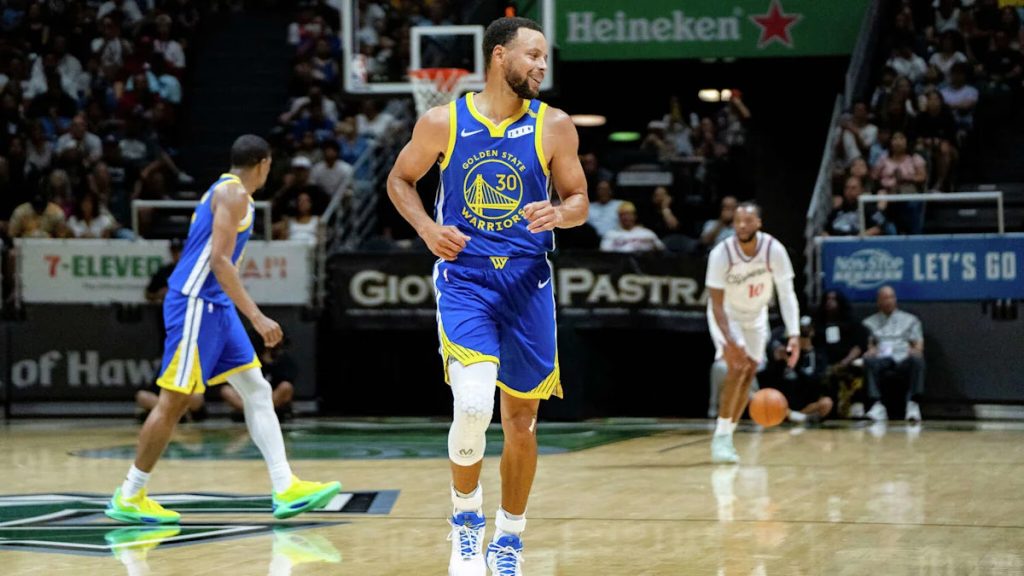
HONOLULU – They were going to need a bigger plane, this time.
Two years ago, when the Golden State Warriors first accepted an invite from the Los Angeles Clippers to play a preseason game in Hawaii and therefore shift training camp away from the mainland, they figured Delta’s classic Boeing 757 would work well enough. A 72-ish seater, recalled Kirk Lacob, the Warriors’ executive vice president of basketball operations.
Advertisement
They thought they had a head count. They thought players would give a couple months’ heads-up on the family and significant others they planned to bring. They thought wrong.
“Now we know there’s this big influx,” Lacob told the Chronicle in late September, “like a week before.”
After 2024’s camp at BYU-Hawaii, Golden State made the executive decision that such a training-camp effort would not be an every-year deal, as Lacob said. Two years later, though, they were back on the North Shore of O’ahu.

Warriors head coach Steve Kerr looks on during Sunday’s exhibition game with the Clippers in Honolulu. The Warriors held training camp in Hawaii at a cost that team executive Kirk Lacob said “is definitely in the seven figures.” (Mengshin Lin/AP Photo/Mengshin Lin)
Such an effort is a “logistical nightmare,” as head coach Steve Kerr said, beyond the simple rigors of regular-season travel planning. Weight-room equipment needs to be transported, and rooms for close to 300 individuals need to be booked, and events – a Thursday-night luau – need to be planned.
Advertisement
“You’re not going to do a trip like this, and then half-ass it,” Lacob said. “What’s the point of that?”
The additional expense to host a training camp in Hawaii, Lacob estimated, “is definitely in the seven figures.” The additional expense to host a training camp at the Chase Center is $0. Golden State had no real massive offseason makeover that would seemingly lend itself to necessary camp chemistry-building, too; 14 of their 21 players were on the roster at the end of last season.
So why, exactly, ship this operation across the Pacific Ocean again?
“Bonding does not, also, only have to be for new relationships,” Lacob said. “Sometimes, the guys who have relationships for a long time – those relationships get a little monotonous. And like I said, we do the same things most years.
Advertisement
“So, even putting guys in a different situation than they’ve been in in the past, will kind of help unlock new relationships between players.”
Such rationale, ultimately, lined up fortuitously and coincidentally with the theme of the Warriors’ entire offseason: rework internal concepts to catch up with a league that has evolved beyond Golden State’s dynastic years. The organization, really, began setting plans for a 2026 Hawaii return roughly a year ago, before this offseason’s wave of continuity. Lacob ran through a cost-benefit analysis of the Hawaii trip last season with general manager Mike Dunleavy and the business-operations staff; two of the three major stakeholders in any such sign-off, though, faced uncertain futures.
Stephen Curry, of course, was locked up. But Draymond Green had a player-option decision to make, then. And Kerr was quite publicly teetering on a decision if he’d return to coach Golden State in 2026-27, after the expiration of his contract.
Lacob wanted Kerr’s blessing, in particular. But in reality, this return to paradise was happening whether he was back at the helm or not.
Advertisement
“We had this conversation in the fall last year, and had no idea if he was coming back,” Lacob said. “I just wanted to make sure he wasn’t against it, necessarily. The way we viewed it, frankly, was like – Steve was very gung-ho about it, thought it was great. And if he wasn’t going to come back, probably was a really good thing to do with like, a new coaching staff, too.”

Golden State Warriors forwards Draymond Green (23) and Yaxel Lendeborg prepare for a potential rebound during a preseason game against the Clippers in Honolulu on Sunday. (Mengshin Lin/AP Photo/Mengshin Lin)
And thus came a week of blue-collar work at a blue-collar gym at BYU-Hawaii, as Green said on his podcast that Day 1 was the “hardest training camp practice” he’d ever experienced in 15 seasons with Golden State. Outside those walls, though, they were free to roam. Players and their families – Moses Moody brought dad Kareem, for one, and Yaxel Lendeborg brought mother Yissel – stayed for nearly a week at the Ritz-Carlton in Turtle Bay, had a golf outing and attended luau with a special fire-dancing performance that had Curry lit up in recollection Sunday.
“We’re locked in on basketball all day, and when practice is pretty much over, I want all the guys to do whatever they want,” Kerr said. “Have fun, go to the beach, play some golf. I believe finding that balance is just fine.
Advertisement
“This is not the 1950s,” he cracked. “We don’t need to keep them from drinking water, and run them into the ground, and starve them.”
There was a price, in sheer organizational lift. There was a price, in sheer – well, price. But team owner Joe Lacob has never been shy to open the pocketbook, if the reasoning is there.
“As long as we weren’t lighting money on fire – because look, I think there’s a reputation that we spend,” Kirk Lacob said. “And that is true. But we’re never reckless with our spending. There is always purpose behind it. Like, it will spend if it gets us something.”
Time, and the on-court product of off-court days in paradise, will tell what it got these Warriors.
Advertisement
Subscribe
There’s more to San Francisco with the Chronicle. Subscribe today for just 25¢.
This article originally published at Why Warriors spent in the ‘seven figures’ to have training camp in Hawaii.


Comments
Advertisement