
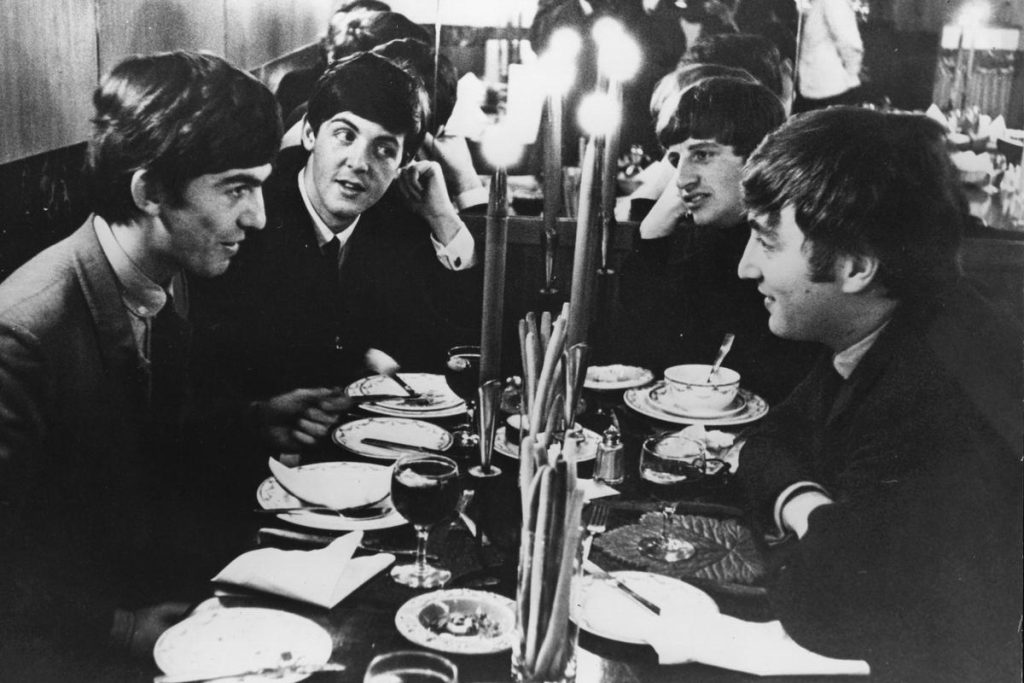
One fact about the Beatles that should not be overlooked is how little calendar time it took them to effectively change the course of music forever.
They officially formed in 1960 (counting the years before the permanent lineup was created) and split up precisely 10 years later — not a lot of time in the grand scheme of things — and yet, their influence was unmatched. Plenty of other artists spend their entire lives crafting a legacy like that, while the Fab Four did it in a decade.
Because they only worked together for a relatively short amount of time, the Beatles only released 13 albums, but each of them paints a different picture of a band working hard to develop something groundbreaking, whether they realized it at the time or not.
The full story of the Beatles is told through these 13 albums, but if we absolutely had to narrow things down to the “Big 4,” these would be our selections.
1. A Hard Day’s Night (1964)
From the opening chord of A Hard Day’s Night, it’s clear that the Beatles were not and never would be a “normal” rock ‘n’ roll band — few ’60s acts at that time would be willing to start an album with such a bizarre sound, one that would leave guitarists wondering for decades how on earth it was made.
Of all of the Beatles’ early albums, A Hard Day’s Night is the one that showcases their burgeoning talent as songwriters — the famous Lennon–McCartney duo, with a sprinkle of George Harrison‘s contributions in there, too — and their penchant for thinking just a bit outside the box. Take, for example, the augmented B7 chord in “I’m Happy Just to Dance With You.” This isn’t your average teeny-bopper music. There’s also “Things We Said Today,” which draws melodically from jazz and classical music, the sort McCartney was brought up on at home in Liverpool, and changes between major and minor keys.
Possibly the craziest part: the whole album was recorded in just nine, non-consecutive days. Not that the band felt strained for time or material, as McCartney relayed in Barry Miles’ Many Years From Now.
“It didn’t seem like pressure. It was – I suppose you’d have to think it was but I don’t remember it being a pressure,” he said. “It was fun, it was great. I always liken songwriting to a conjurer pulling a rabbit out of a hat. Now you see it, now you don’t. If I now pick up a guitar and start to conjure something out of the air, there’s a great magic about it. Where there was nothing, now there is something. Where there was a white sheet of paper, there’s a page we can read. Where there was no tune and no lyrics, there’s now a song we can sing! That aspect of it made it a lot of fun. We’d be amazed to see what kind of rabbit we’d pulled out that day.”
Listen to the Title Track to ‘A Hard Day’s Night’
2. Revolver (1966)
Skip ahead a mere two years and you’ll find the Beatles had arrived in an entirely new and much stranger place with Revolver. These days, it’s commonplace to think of the recording studio as an instrument itself, but back in 1966, the Beatles were one of the first bands to move full steam ahead with this approach, engaging with things like double tracking, reversed taping and unorthodox microphone placement. Why not utilize the technology at hand?
There are much more mature themes present on Revolver: death, spiritual transcendence, loneliness, what lies beyond the grave, etc. And from a strictly musical perspective, it isn’t hard to see how Revolver set a sort of template for the kind of music that would come a bit later, genres including psychedelic rock, electronica, prog rock and shoegaze. For arguably the first time in the Beatles recording career, each of the members’ respective personalities appeared to shine through without overpowering one another: Harrison’s innovative use of the sitar and other Eastern influences (“Love You To”), Lennon’s cynical lyricism (“She Said She Said”), McCartney’s proclivity for writing songs that felt like instant classics (“Here, There and Everywhere”) and Ringo Starr‘s unique ability to brighten any space with a single song (“Yellow Submarine”).
Rock music changed a great deal over the course of the ’60s, and Revolver was an undeniable cornerstone of that progression.
Listen to ‘And Your Bird Can Sing’ From ‘Revolver’
READ MORE: Top 20 Acoustic Beatles Songs
3. Sgt. Pepper’s Lonely Hearts Club Band (1967)
It’s not really possible to pin down the very first concept album, but it could certainly be argued that Sgt. Pepper’s Lonely Hearts Club Band is one of the earliest examples of such an approach to album-making.
Sgt. Pepper was an explosion of all things psychedelic, a foray into something much more mystical, artistic and downright weird. Once again, the studio itself became as much an instrument as any of the Beatles guitars, combined with string orchestras and horn sections. And even though the Beatles could mask themselves somewhat behind the alter ego of a fictional band, they still were able to maintain a strong sense of teamwork.
“It was a peak, and Paul and I definitely were working together, especially on ‘A Day in the Life,'” Lennon later said. “I don’t like production so much, but Pepper was a peak, all right.”
It’s difficult to describe the impact of Sgt. Pepper, but it’s obvious when the album is playing. If there was ever a musical signifier that the times were changing, this would be it. In many ways, rock music was black and white before Pepper turned things into color.
Listen to the Title Track to ‘Sgt. Pepper’s Lonely Hearts Club Band’
4. Abbey Road (1969)
It’s true that by 1969, the members of the Beatles were struggling in their relationships with one another, not always seeing eye to eye in the studio. Yet, there’s a feeling of consistency to Abbey Road.
Abbey Road simplifies things — it’s not as technically produced as Sgt. Pepper and leans more so on the strength of their songwriting. Back then, it didn’t necessarily astound critics, though it did top the charts in both the U.S. and the U.K. “What’s to say? If you like the Beatles, you’ll like the record,” John Gabree wrote in High Fidelity. “If you have your doubts, this will do nothing to allay them. Of course, as someone just said, they do have ‘something.'”
But where else could you find something as lighthearted and beautifully silly as “Octopus’ Garden,” or as deeply romantic and starry-eyed as “Something” or as adorably quirky as “Maxwell’s Silver Hammer,” but on a Beatles album? Pristinely recorded, Abbey Road serves up a little something for everyone and showcases just how far the Beatles came professionally in less than a decade.
“The second side is brilliant,” Starr said for Anthology. “Out of the ashes of all that madness, that last section is for me one of the finest pieces we put together.”
Listen to ‘Come Together’ From ‘Abbey Road’
Beatles Live Albums Ranked
Beatles live albums didn’t really used to be a thing – then they started arriving in bunches. Let’s count them down.
Gallery Credit: Nick DeRiso


Comments
Advertisement