
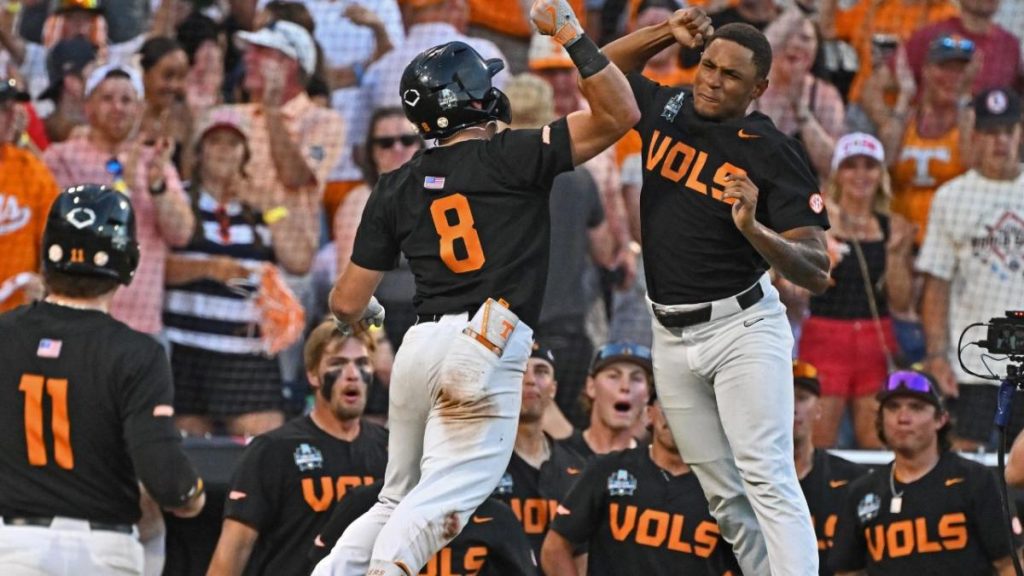

University of Tennessee first baseman Alberto Osuna sued the NCAA on Wednesday, demanding a temporary restraining order and a preliminary injunction to let him play D-I baseball this spring. Osuna, 24, is the latest “seasoned” college athlete to insist that NCAA eligibility rules run afoul of antitrust law not only because they prevent an extended collegiate career, but also because they deny athletes’ the chance to enjoy potential NIL deals and revenue sharing opportunities.
Late Thursday, U.S. District Judge Charles E. Atchley, Jr. denied Osuna a restraining order. The judge scheduled a hearing on Feb. 26 in Knoxville, Tenn., for a potential injunction.
More from Sportico.com
Osuna’s case is interesting because college baseball competes with MLB for player labor. Players can join MLB organizations straight out of high school or after they attend college. Generally, a player who attends a junior college is draft-eligible after one year, whereas those who attend a four-year college are draft eligible after their junior year or when they turn 21. With NIL opportunities and potential revenue sharing, some players will be inclined to stay in college as long as possible to maximize their earnings and develop their skills before they join MLB organizations as minor league players, who are still paid modest wages (though better wages than recent years).
Osuna’s collegiate journey began in the fall of 2019, when he enrolled at Walters State Community College in Tennessee. His spring 2020 baseball season was cut short due to the COVID-19 pandemic, but he played in 2021 and was named the NJCAA D-I Player of the Year. He then enrolled at North Carolina and played there for the 2022, 2023 and 2024 seasons. Osuna, who blasted 45 home runs during his three years as a Tar Heel and was a preseason All-American in 2023, says he earned NIL money while at UNC. He received his bachelor’s degree in 2024.
By that point, Osuna had exhausted his NCAA D-I eligibility, which permits four seasons within five years. He entered the 2024 MLB draft but was not picked. Osuna then enrolled at the University of Tampa in the fall of 2024 to pursue a graduate degree in entrepreneurship and play D-II baseball. He would have preferred to keep playing D-I college baseball had that been an option.
But last December, Osuna saw Vanderbilt quarterback and former junior college transfer Diego Pavia convince a federal judge in Tennessee to grant a preliminary injunction to let him play D-I football last fall—and the baseball player realized he had a lot in common with the football player.
Osuna—represented by attorneys Chad Hatmaker and Kaitlyn Hutcherson of Woolf, McClane, Bright, Allen & Carpenter—says he and Pavia share “identical collegiate eligibility records,” in that both saw their 2020 seasons wiped out due to the pandemic and both played one year of JUCO and three years of D-I. Osuna also emphasizes that, like Pavia, he stands to lose out on economic opportunities that would come with potential NIL deals and potential revenue sharing (if the NCAA’s settlement in the House, Carter and Hubbard antitrust litigations is approved).
The NCAA appealed Pavia’s injunction to the U.S. Court of Appeals for the Sixth Circuit, but as that appeal plays out, the NCAA granted a waiver to similarly situated former JUCO players to play a fourth year of D-I in fall 2025 or spring 2026.
Osuna, however, wants to play D-I in spring 2025. Therein lies the problem.
Osuna entered the transfer portal on Jan. 13, and says that Tennessee began recruiting him just one day after. He contends that “NIL opportunities” and other resources at Tennessee—which won the College World Series in 2024 and is one of the best college baseball programs in the country—are better than those at other D-I programs. He was admitted as a transfer from Tampa, where his complaint says he had earned a 3.8 GPA, and is now a student at Tennessee.
The NCAA has not cleared Osuna to play in spring 2025, so he turned to the courts. Osuna’s legal arguments are familiar by this point. He contends NCAA eligibility rules violate antitrust laws, since competing businesses (colleges) join hands to agree they will limit athlete eligibility in ways that prevent ineligible athletes from NIL and other economic opportunities.
The NCAA sees it differently. Represented by David J. Zeitlin and Taylor J. Askew of Holland & Knight, the NCAA argues Osuna lacks a viable argument. He is simply asking, the NCAA charges, to play another D-I season “following his exhaustion” of rules “applicable to similarly situated” D-I athletes. The NCAA also contends Osuna could have challenged the eligibility restriction earlier, noting that he waited until after his eligibility expired and after he wasn’t picked in the MLB draft to seek another year.
Atchley held a hearing on Thursday afternoon to review Osuna’s request for a TRO that would block the NCAA from declaring him ineligible for the spring 2025 season, which begins on Friday. By the evening the judge had rejected the request. Atchley stressed that TROs are “extraordinary remedies” that are appropriate when they, among other things, preserve the status quo. The judge underscored the status quo, which means Osuna is ineligible to play, and that Osuna “asks the Court to disturb the status quo.”
Atchley reasoned that given “this lawsuit is one day old,” Osuna has not offered enough evidence to warrant an extraordinary remedy, especially since he could have avoided a last-minute rush to court. “Plaintiff,” Atchley wrote, “knew of his eligibility predicament when he transferred to the University of Tampa in the Fall of 2024.”
Osuna will have another shot to play on Feb. 26 with the preliminary injunction hearing.
Best of Sportico.com
Sign up for Sportico’s Newsletter. For the latest news, follow us on Facebook, Twitter, and Instagram.


Comments
Advertisement