
When Sean Mannion officially took over as the Philadelphia Eagles’ offensive coordinator, much of the early conversation centered around one obvious question.
What kind of offense would he build? What exactly will Philadelphia’s offense look like under a first-time NFL play-caller stepping into one of football’s highest-pressure jobs? For months, speculation dominated the conversation. Would Mannion bring an entirely new system? Would he lean heavily into concepts from his own background? Or would Philadelphia prioritize continuity around Jalen Hurts and an offense still loaded with high-end talent despite offseason changes?
Advertisement
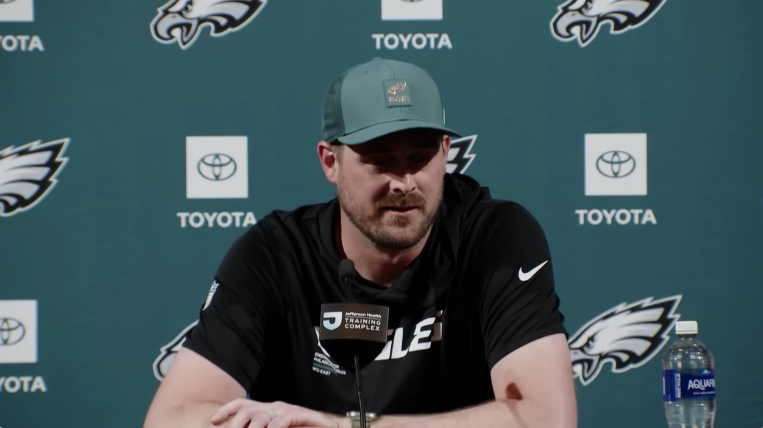
During media availability last week, Mannion offered perhaps his clearest insight yet into how he plans to approach the challenge, and Eagles fans will probably appreciate the philosophy. Asked by Eliot Shorr-Parks how he balances his own schematic beliefs with adapting to the personnel already in place, Mannion made it clear that the answer isn’t rigidity.
It’s evolution.
“There are things I believe in, and there are things that schematically I have a background in, but ultimately it’s going to be a blend, and it’s constantly going to evolve,” Mannion explained. “It’s all with that exact goal in mind that you just said. It’s about maximizing things for the players. How do we make the Eagles the best team we can be, how we make the Eagles offense the best it can be and how do we put all of our players in a position to really, really succeed and maximize their strengths.”
That answer feels particularly important, given where Philadelphia stands heading into 2026.
The Eagles aren’t asking Mannion to oversee a rebuild. They’re asking him to maintain a championship window while helping stabilize an offense that showed flashes of dominance but also had disappointing, implausible stretches of inconsistency late last season under Kevin Patullo. Philadelphia still has Jalen Hurts. The offensive line remains among football’s strengths despite replacing legendary offensive line coach Jeff Stoutland with Chris Kuper. The skill position room has been reshaped aggressively, creating both opportunity and pressure.
Advertisement
That reality makes Mannion’s approach feel significant.
The NFL increasingly punishes coordinators who become overly attached to systems rather than players. Great offenses adapt. Personnel changes. Defensive trends evolve. The best play-callers consistently find ways to highlight strengths while minimizing weaknesses. Mannion sounds fully aware of that responsibility.
Building around Hurts’ mobility, maximizing mismatches, leaning into versatility, and allowing offensive concepts to evolve naturally based on personnel feels like the correct approach for a roster designed to compete immediately.
Early offseason press conferences don’t win games, and philosophy alone doesn’t produce points in meaningful late January games. Eventually, Philadelphia will judge Mannion on offensive efficiency, situational execution, explosive plays, and whether this offense performs like one capable of competing for another Lombardi Trophy.
Advertisement
Still, if the early messaging offers any indication, Mannion understands the assignment. Philadelphia doesn’t need an offensive coordinator determined to force players into a system.
The Eagles need someone willing to build a system around the players already capable of winning championships.
This article originally appeared on Eagles Wire: Sean Mannion reveals key philosophy that will guide the Eagles attack
Comments
Advertisement