
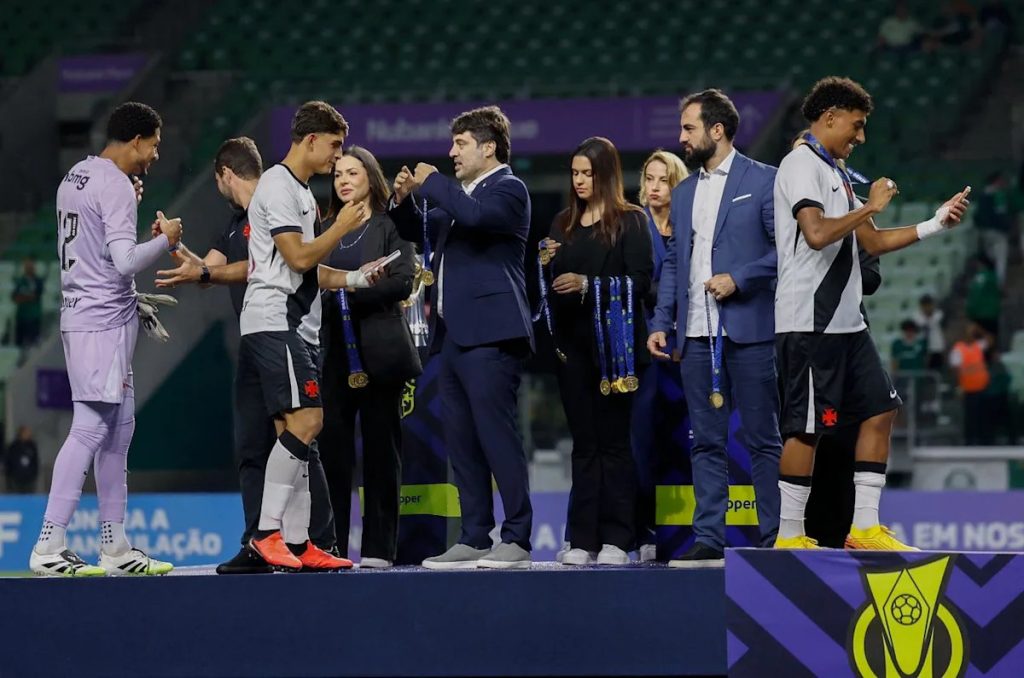

Julio Avellar celebrated the success of the Brasileirão U-20Credits: Rafael Ribeiro / CBF
Vasco’s historic first-ever Brazilian U-20 Championship title brought an edition to a close that, for the CBF, also represents a step forward in expanding the youth-category calendar. The federation’s Competitions Director, Julio Avellar, highlighted the number of matches organized throughout the season and said the work will continue in the coming years.
Advertisement
The CBF staged more than 700 youth competition matches in 2026, a number that marks a historic record. The growth is part of the federation’s strategy to give youth development categories more space in the national calendar.
“We started a youth calendar with more than 700 matches. It’s a historic record for the CBF. It is the result of shared management, with president Samir [Xaud] giving a lot of support to all departments to innovate. So we’re on a very good path,” he said.
In the Brazilian U-20 Championship, there were 204 matches this season, six more than in 2025. The edition also featured an important change to the knockout stage, with second-leg matches in the quarterfinals and semifinals. For Avellar, the new format made the decisive stretch even more competitive.
“A competition with 204 matches this year, six more than the previous year, with second legs in the quarterfinals and semifinals. Two teams where the title could have gone to either one, both with excellent campaigns,” he stressed.
Advertisement
The final between Vasco and Palmeiras ended up being an example of the balance Avellar referred to. After losing the first match 1-0 at São Januário, Vasco won 2-0 at Nubank Parque, turned the tie around, and won the Brazilian U-20 Championship for the first time.
The expansion of competitions, however, is only one of the fronts under discussion at the CBF. Created this year, the Youth Categories Working Group brings together clubs, federations, specialists, former players, and representatives of the federation itself to discuss structural changes in player development. Among the topics already on the agenda are the calendar, youth academy club models, the regulation of agents, and the development of women’s youth football.
It is precisely within this group that the CBF intends to discuss the next steps for the development categories. Avellar says new proposals are being built, without giving advance details on which changes may be implemented.
“Everyone works for strong youth football. We are now working in the youth working group, with more innovations and more new developments that should be coming,” he said.
Advertisement
The executive also stressed that the intention is to maintain the process of expanding and improving competitions in the coming years.
“That’s it. Stay tuned, because next year there’ll be more,” Avellar concluded.
This article was translated into English by Artificial Intelligence. You can read the original version in 🇧🇷 here.


Comments
Advertisement