
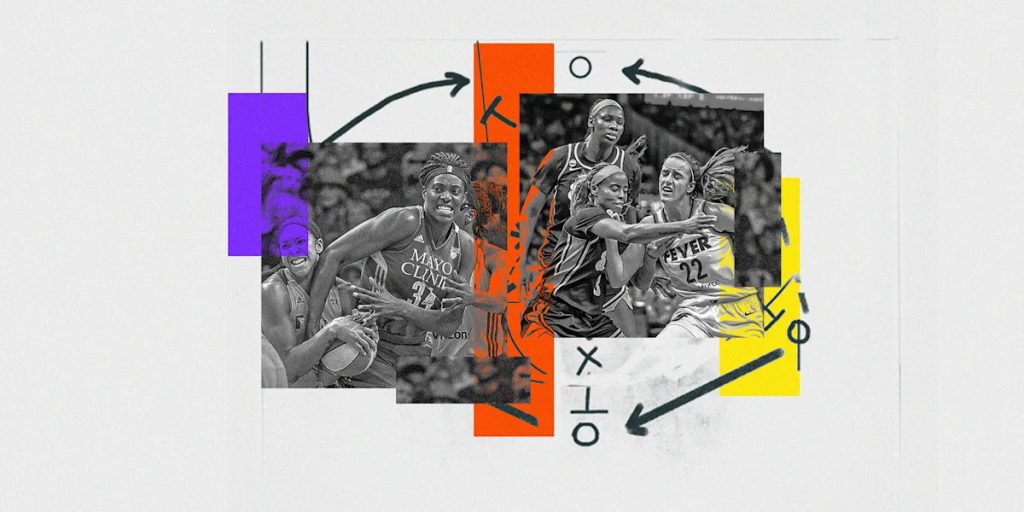
The palpable tension in the WNBA over how basketball is played broke wide open in the contact last week between Caitlin Clark and Alyssa Thomas. In one sect is an old-guard contingent so deeply accustomed to bruises and scratch marks that they wear them as a badge of pride. In another, an increasingly loud set of stars is pushing against the notion, arguing for a free-flowing style showcasing skill over force.
It’s a cataclysmic divide that grows starker after each officiating controversy. Nothing showcased this better than a remark by Clark’s former teammate and a longer-tenured veteran than Thomas, after the latter was assessed a flagrant 2 for contact to Clark’s throat.
Advertisement
“Do I think it was a flagrant?” Colson, an 11-year veteran and two-time champion with the Aces, said during ESPN’s “WNBA Countdown” on Sunday. “Not at all. But I also grew up in an era where it’s very physical and this was the least of what I would consider a flagrant 2.”
In an older era, entrance to the clubhouse’s inner sanctum is gained via “welcome to the league” moments, a gatekeeper’s ritual rife with underhanded contact behind a referee’s back.
Colloquially known as the Diana Taurasi rite of passage, it dominated a WNBA marketing campaign and its all-time leading scorer’s retirement package. There’s an ideology that they went through it, so everyone else must, too. It might as well be an understandable overcompensation for the decades when women were discouraged from participating in the most benign physical activity by their own doctors.

The WNBA is evolving from the days of Diana Taurasi, but not everyone’s a fan of how physicality is officiated. (Photo by Ethan Miller/Getty Images)
(Ethan Miller via Getty Images)
“There’s a celebration to being like, ‘I’m bigger than you,'” retired point guard Layshia Clarendon said on her “No Offseason” podcast, describing, and largely supporting, a physical league. “And I don’t want that to be shied away from because we’re women and it’s a women’s league. Being big and being stronger is a part of competitive advantage. It’s a big girls’ league.”
Advertisement
But there’s an emerging and increasingly emboldened group building its own clubhouse, detaching itself from the way it’s always been. While Clark’s name is the one on the marquee, she and Fever head coach Stephanie White are far from the only ones pushing for a cleaner, less brutally physical game that protects players.
Las Vegas Aces two-time champion head coach Becky Hammon holds a running tab of fines with the league office for her free-flowing remarks on officiating. Minnesota Lynx president of basketball operations and 17-year head coach Cheryl Reeve, set to become the winningest coach in WNBA history, unloaded her chamber during last year’s playoffs.
Within days of that, 2025 MVP runner-up Napheesa Collier took a hacksaw to the cliquey “old guard” house with similarly scathing remarks on the league’s officiating issues. It was far from the first time players called out a distaste for physical play.
Given the time and situation, Collier’s was the message with the greatest reverberation. The WNBA Players Association (WNBPA) applauded the move, sharing it on their own social platforms. There was an internal hope that a tougher restructuring of officiating and the structure around it would be included in the new collective bargaining agreement (CBA), but that was not part of the final deal. An officiating task force, which includes White, Reeve and Hammon, among others, was established during the offseason, but its activities and impact have been largely unclear.
Advertisement
The players union has not stepped into the fray, staying silent this past week except to announce the results of its leadership election last week. Nneka Ogwumike will serve a fourth term as president, while Collier replaces Plum as first vice president after the latter did not run again. Collier also has not made any comments on officiating since an in-depth preseason NPR interview in which she said, again, that the game is too physical and she supports rule “tweaks” that “cater to the offensive player.”
“We’re competitors,” said Collier, who underwent surgery on both ankles in the offseason and returned to practice this week. “We want to win. And if the rules allow, we’re going to kill each other to get there. I just think the rules need to change in that regard so that it’s safety for others, and a better experience for the fans, as well.”
Thomas sitting at the center of last year’s and this year’s season-shaking individual plays is no coincidence. But while the swift claims of her being a dirty player quick-dry, it’s actually easier to paint the picture of a slightly undersized veteran forward designing her MVP-caliber game on the edge in the exact manner Colson, Clarendon and Collier described. Not only has the league and its players by and large allowed this style, but they’ve also celebrated and supported it, too.
Think about how many former players this week have skirted around identifying that as a flagrant 2, which by rule is assessed “if contact committed against a player, with or without the ball, is interpreted to be unnecessary and excessive.”

While some take issue with Alyssa Thomas’ playing style, it’s one that’s garnered her long-term success in a league that’s often celebrated physical play. (Photo by Michael Hickey/Getty Images)
(Michael Hickey via Getty Images)
To a newer fan unclear on such history of physical play — and considering how many games crested viewership of 1 million in recent seasons, there are many — that’s as clear a violation as they come. Thomas, purposely or not, pushed her fist into Clark’s neck while the guard struggled on the ground. As Hall of Famer Lisa Leslie pointed out this week, it could have all been different had there been the old-school approach of helping Clark up or quickly checking on her in the aftermath.
Advertisement
So the larger issue is that a significant contingent of embedded fans, former players and active ones — particularly veterans — do not deem that play unnecessary or excessive. Nor do they deem others as such. And to complicate matters, there’s a comparison made to previous, comparable plays over the league’s existence that have not been called flagrant. They are holding on to their WNBA, everyone else be damned.
In a season focused on officiating, it is a demarcation between the groups that the league and its officiating arm will need to uphold. One of the sides will win here, because either the WNBA carries on with the status quo of a product more fitting on a hockey rink, or it takes a more serious step of adjusting its game the way the NBA did before it.
Stakeholders around the league are correct that it doesn’t need to copy and paste the trajectory of the men’s side. Yet, sometimes it should when it makes sense. Taking that step necessitates an acceptance of angering its former player populace, a controversial move it’s often unwilling to take. This one will take longer than a single season, forcing its active players to adjust in real time and endure the consequences of choppy gameplay and escalating free-throw numbers.
What should embolden them is that the newer clubhouse is gaining vocal membership. Candace Parker (two MVPs, three championships with three different teams), Elena Delle Donne (two MVPs, one championship) and Reeve (four championships) all told ESPN ahead of their inductions to the Women’s Basketball Hall of Fame on Saturday that the league needs to do a better job of protecting players and limiting excessive contact.
Advertisement
“The physicality has always been there,” Parker said. “It’s just now you’re having more visibility and new fans and new opinions coming into the game. Because we went through [so much physicality] does not mean that I think that [it has to be that way].”
Parker and Delle Donne came up as highly touted high school prospects for their guard abilities as post players. Those types are increasingly the norm in a more position-less WNBA, another natural mimic of the NBA before it, as young kids specialize in one sport while generalizing in all positions.
In December 2006, the New York Times introduced Delle Donne to a national audience with the headline, “She’s 6-5 and 17, With the Potential to Alter the Game.” And she did. The No. 2 pick in the 2013 draft finished third in MVP voting as a rookie and became the first 50/40/90 player in WNBA history, leading a historically elite Washington Mystics offense to the 2019 championship.
That’s where her career unceremoniously came to a close — there was no parade since players immediately reported to their overseas clubs and the world locked down under COVID-19 protocols in 2020. Delle Donne played through three herniated discs in the Finals, sat out the 2020 season due to medical concerns complicated by Lyme disease, and played only three games in 2021 after two back surgeries. Following shortened seasons in 2022-23, she announced her retirement ahead of the 2025 season.
Advertisement
“Trust me, my back wishes I had had a little more of that,” Delle Donne told ESPN of the so-called officiating emphasis on freedom of movement. “It’s more fun to watch, and there are such skilled players out there. We want to see them do what they can do. We don’t want to just see them get beat up.”
The back issue first popped up for Delle Donne in the 2019 playoffs. She played through to the WNBA Finals with a bulging disk in her lower back, but missed the FIBA World Championships with the lingering injury.
Though there is no direct reported causation between her back injuries and the physicality level of the WNBA, it’s easy to see a potential (and concerning) parallel with Clark. White said last season that physicality factored into Clark’s string of soft tissue injuries, emphasizing the importance of freedom of movement.
Advertisement
Clark’s back issue first came to light in this year’s season opener, and Clark remained on the availability report after the Fever were warned about their reporting tactics. She was not at team practice on Tuesday. Instead, White said she was doing an individual workout. It is unclear the exact nature of Clark’s injury.
League-wide, free throws are up, game time is ballooning and patience may be waning.
“We’ve got to get through this learning period of, ‘OK, we can’t crush each other anymore,'” Delle Donne said. “Let’s play good basketball.”
The glaring issue the WNBA needs to approach head-on? Everyone is clinging to diametrically opposed definitions of what good basketball means.


Comments
Advertisement