
The final week of the regular season featured four series involving projected postseason teams, offering an unofficial first glimpse at the kind of matchups we’ll see next month. The highest stakes have not quite arrived, but the collective talent on display provided some semblance of a preview for the October tournament. Consider these games the final tuneups for these ballclubs and one of the final chances for certain players to make their case to be key contributors in the postseason.
Here’s how those four series unfolded, with one takeaway question for each team that should remain top-of-mind as the postseason gets underway.
Advertisement
Subscribe to Yahoo! Sports MLB on YouTube for videos, podcasts and more
Results: 2-0 Yankees, 6-1 Rays, 9-2 Yankees, 6-4 Yankees
Rays: Where does Drew Rasmussen rank among postseason aces?
The Yankees took this series, but the Rays needed only one win in the Bronx to clinch the AL East crown, and they got it behind a stellar outing from Rasmussen in the nightcap of Tuesday’s doubleheader. Rasmussen allowed 1 run on 1 hit and struck out 11 across 6 ⅔ innings, exactly the kind of outing the Rays were looking for from their best pitcher to secure the division title. But perhaps the most notable part of Rasmussen’s statline — and the one that encapsulates the urgency with which Tampa Bay approached that clinching game — was his pitch count: 114.
Advertisement
For much of baseball history, such a total would not have raised many eyebrows. But these days, managers have become increasingly reluctant to let their starters even come close to that number. The trend over the past three decades is staggering and extreme. Here’s how many times a starter threw at least 114 pitches in a game in each regular season:
1996: 803
2006: 374
2016: 167
2026: 8
It’s no surprise then that Tuesday represented by far a career-high pitch count for Rasmussen, who battled myriad injuries earlier in his career before proving quite durable over the past two seasons. In fact, Rasmussen had never thrown more than 97 pitches in an outing before this year, when he’s done it six times. And that longer leash has been well-earned, as Rasmussen has cruised along as one of the most dependable starters in the majors, a metronome of run prevention like few others.
Various ailments have interrupted his availability and altered his role at times, but the numbers speak for themselves: Among 89 arms with at least 500 innings pitched since the start of the 2022 season, Rasmussen’s 2.74 ERA ranks fourth behind only Tarik Skubal (2.66), Blake Snell (2.69) and Chris Sale (2.71). A deep arsenal headlined by a balanced diet of three fastball variations (29% cutter, 28% four-seam, 24% sinker) makes game-planning for Rasmussen a tough task, and he’s throwing more strikes than ever, running a career-low 4.8% walk rate that is bested only by his teammate Nick Martinez among qualified starters.
Advertisement
He might not get the attention of some of the other top arms in the league – Rays rarely do — but Rasmussen is unquestionably one of the best pitchers atop any postseason rotation, and he’s a huge reason the Rays are perched comfortably atop the American League.
Yankees: Who is New York’s third-best starter?
The Yankees have hinted that AL Cy Young favorite Cam Schlittler might not get the ball in Game 1 of next week’s wild-card series as most assumed, suggesting that he would instead start Game 2 with lefty Max Fried going in Game 1. Either way, it’s a safe bet that Fried and Schlittler will start the first two games. But then what?
If the Yankees sweep their opponent (likely the Red Sox) next week, this decision won’t have to be made until Game 1 of the division series against Tampa Bay. But if the wild-card round stretches to a decisive Game 3, it’ll be fascinating to see whether New York hands the ball to Gerrit Cole or Carlos Rodón, both of whom pitched against the Rays in their final regular-season outings. In Game 1 of Tuesday’s doubleheader, Rodón delivered one of his best starts as a Yankee, tossing eight scoreless innings with eight strikeouts and zero walks. Cole followed Wednesday with a more mediocre showing, needing 105 pitches to complete 5 ⅔ innings with two runs allowed in New York’s 9-2 victory.
Advertisement
It has been a strange season for the 36-year-old Cole in his return from Tommy John surgery, as his plus velocity has returned and he’s throwing more strikes than ever (4.8% walk rate is a career low), yet whiffs have been harder to come by and he has surrendered a ton of hard contact, often in the air. That latter trait is a dangerous one come October, when homers can be devastating, so it wouldn’t be surprising if the Yankees prefer the lefty Rodón, whose run prevention this year (2.67 ERA) has been much more reliable, in a winner-take-all situation. You can make a strong case for either, but it’ll be interesting to see which direction the Yankees go.
Results: 6-4 Phillies, 4-1 Brewers, 5-1 Brewers
Advertisement
Phillies: Can Brandon Marsh rediscover his All-Star form?
The Phillies are sweating a bit heading into the final weekend, with just a two-game lead over the Arizona Diamondbacks with three games to play. Philadelphia welcomes the AL-leading Rays to Citizens Bank Park this weekend, hardly an ideal matchup considering the circumstances, but it’s worth noting that the Rays have nothing left to play for in the regular season. The D-backs also face a tough opponent in the Padres, so it’s tough to project how this NL wild-card race will shake out.
If there was one encouraging sign for Philadelphia to draw from this week’s series loss, it’s the long-awaited breakthrough for outfielder Brandon Marsh, who drove in three runs with a double and a homer in the Phillies’ 6-4 win on Tuesday. It was Marsh’s first multihit game since Aug. 21 and his first game with multiple extra-base hits since a two-homer performance way back on June 29.
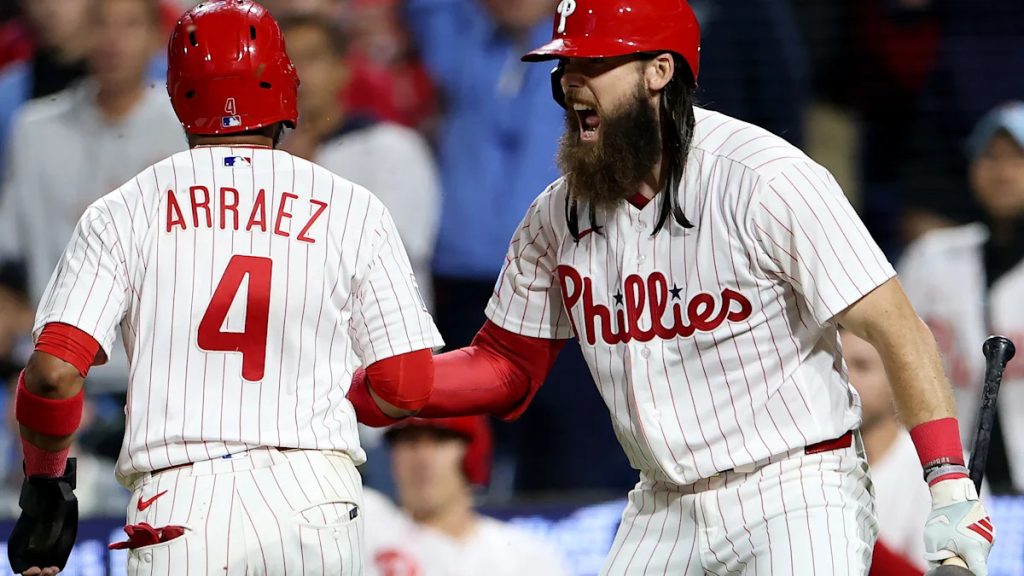
A terrific first half earned Marsh his first All-Star appearance this summer, and the fans voted him a starter for the Midsummer Classic played at his home ballpark. But Marsh has looked lost at the plate since the break, hitting .180 with a .475 OPS across 57 games before his slugging outburst Tuesday. This Phillies’ lineup could use any sort of spark right now — to help finally clinch a playoff spot and once October begins — especially if Luis Arraez is compromised or unavailable due to his left ankle injury suffered Thursday. A rejuvenated Marsh would be a welcome development.
Advertisement
Brewers: Who starts Game 3?
The Brewers already know they’re preparing for a best-of-five division series, giving them a whole week’s rest and ample time to map out their postseason pitching plans. But as the regular season draws to a close, even the team with the best record in the majors (and a franchise-record 100 wins) faces some serious questions about its postseason rotation. As with New York, the first two starters are apparent in super-ace Jacob Misiorowski and outstanding right-handed rookie Logan Henderson. But it gets cloudy after that, especially with the recent struggles of lefty Kyle Harrison, who has spiraled down the stretch into a bout of severe ineffectiveness after pitching at an elite level the first couple months.
Harrison might still factor into the pitching plans, but it’s hard to envision him drawing a start in his current state. As such, there’s substantial pressure on trade-deadline acquisition Dustin May — who has not appeared in the postseason since 2020 — to stabilize his performance entering October, though his 5.61 ERA across 33 ⅔ innings since joining Milwaukee does not inspire much confidence. Perhaps May and Harrison can serve in a piggyback role, like they did in Tuesday’s game in Philadelphia, though that doesn’t sound like a top-notch Plan A.
Advertisement
Otherwise, it could fall on a pair of rookie lefties in Shane Drohan, who has been shaky in September, or Robert Gasser, who threw seven scoreless innings in Baltimore last weekend but did not appear in this Phillies series. Behind the shallow group of starters, Milwaukee’s bullpen is stout as always, so there’s a path to covering the requisite innings with a plethora of nasty relievers. But if the Brewers are to make a deep run this postseason, at least one unexpected starting pitcher needs to step up in a big way.
Guardians at Red Sox
Results: 3-2 Guardians, 1-0 Red Sox, 1-0 Guardians
Guardians: How much better is the offense compared to last year?
If you went to Fenway Park this week hoping to see a bunch of runs, my condolences. But the Guardians did clinch a postseason berth — their eighth in the past 11 seasons — by winning the series, even with minimal offensive fireworks. Work remains to be done on the final weekend if Cleveland wants to claim its third straight AL Central title, as the White Sox are only one game back, own the tiebreaker and face the 102-loss Rockies at home while the Guardians head to Kansas City.
Advertisement
But however it shakes out, we know the Guardians will have another opportunity to prove that their brand of baseball can succeed in October. Cleveland authored a historic comeback last year to rally past Detroit and win the division, then arrived in the postseason with one of the weakest lineups to ever qualify for the playoffs.
What about this year’s Guardians offense? Let’s take a look:
2025:
-
Runs per game: 3.97 (28th)
-
Strikeout rate: 22.6% (15th)
2026:
-
Runs per game: 4.11 (27th)
-
Strikeout rate: 21% (5th)
It might not look much better at first glance, but the personnel is much different (or improved), and there’s optimism to draw from that. Former No. 1 pick Travis Bazzana has provided a real boost as a rookie. Trade-deadline acquisitions Jo Adell and Nathaniel Lowe have brought veteran experience and slugging upside. Angel Martinez has taken a meaningful step forward; his team-leading 18th home run was the sole run on Thursday. Chase DeLauter has a full season of standout production under his belt after debuting in the postseason last year. And perhaps most importantly, José Ramírez is starting to look more like himself lately.
Advertisement
Even if this new-look offense represents an upgrade, the pitching will likely still have to carry Cleveland in October. But there are more bats to take seriously in this year’s Guardians lineup, and that should not be dismissed, even if their offensive ranks still lag behind those of their postseason peers.
Red Sox: How high is Tyron Guerrero in the bullpen hierarchy?
One of the most incredible under-the-radar stories of the season has been the reemergence of Tyron Guerrero. The 35-year-old had not pitched in the majors since 2019 before he latched on with the Red Sox on a minor-league deal in January, but it took all of 15 dominant appearances in Triple-A before it became clear the gargantuan right-hander belonged in a big-league bullpen again. Boston called him up in mid-May, and he has been mostly terrific ever since. He struck out the side in the seventh inning of Boston’s victory on Wednesday.
Guerrero tantalized with his elite velocity years ago, first as a prospect with the Padres and then in the majors with the Marlins, but his control was so erratic that he was downright bad in those early opportunities: Among 108 relievers who logged 100-plus innings across the 2018 and ’19 seasons, Guerrero’s 5.80 ERA ranked 106th. That inconsistency sent him on a half-decade odyssey bouncing among different ballclubs around the world, with stints in the minors as well as stops in Mexico, Japan and the Dominican Republic for winter ball. Now he’s back in the big leagues and, most improbably, throwing a boatload of strikes (4.8% walk rate!) while continuing to unleash absolute heat; only Mason Miller, Edgardo Henriquez, Jacob Misiorowski and Jhoan Duran have a higher average fastball velocity than Guerrero’s 100.2 mph sinker.
Advertisement
It’s almost comical the degree to which Guerrero relies on that two-seamer: At 86.2%, it’s the highest usage for any individual offering from any pitcher in the league. On Wednesday, it accounted for 21 of his 22 pitches against Cleveland. But it’s hard to argue with the results, and Guerrero has been exceptional at coaxing chase and weak contact, giving manager Chad Tracy yet another incredible resource to lean on late in games. We’ll see how Guerrero fares in his long-awaited postseason debut, but it’s already one heck of a story.
Results: 7-0 Dodgers, 5-1 Padres, 4-2 Padres
Advertisement
Dodgers: How does Shohei Ohtani look at the plate?
It’s not just that Shohei Ohtani wasn’t producing at an impact level before he landed on the injured list for the first time as a Dodger. It’s that he looked out-of-sorts at the plate in a way that clearly required intervention. And so the four-time MVP missed 13 games as he worked to recover from his nagging right biceps and left knee ailments.
Based on how Ohtani swung the bat against San Diego in the two games since he was activated, the Dodgers have to feel much better about his ability to contribute at the top of the lineup than they did a couple of weeks ago. On Wednesday, Ohtani smoked a single off lefty Robbie Ray in his first at-bat and later made flush contact (103.4 mph exit velocity) with a 99-mph fastball from Bradgley Rodriguez, launching it deep to center field before it fell into Jackson Merrill‘s glove. In the ninth, Ohtani went down flailing against a Mason Miller slider for his second strikeout of the game. But on Thursday, after a couple more well-struck warning-track flyouts and a sharp single, Ohtani won his second encounter with the mighty Miller, smashing a 102.6-mph fastball into the left-center-field gap for an RBI double.
These are the kinds of swings that Ohtani was rarely producing in the weeks leading up to his trip to the injured list, so to see him look this comfortable fresh off being activated is an incredibly encouraging sign for Los Angeles. Look for Ohtani to do more damage this weekend against a depleted Giants pitching staff as he gears up for another postseason run.
Advertisement
Padres: Nick Pivetta has to start a wild-card game, right?
After putting together a career year in his first season as a Padre in 2025, Nick Pivetta made just four starts this April before landing on the injured list due to right elbow inflammation, a brutal blow to a San Diego rotation that was already quite thin. That pushed Pivetta largely off the radar for four months as he worked his way back, and in the meantime, the Padres acquired two starting pitchers at the trade deadline in Ray and Casey Mize to backfill some of the innings that needed to be covered in Pivetta’s ongoing absence.
Pivetta finally rejoined the rotation earlier this month and has quickly reminded everyone what San Diego was missing. The Padres have won his first four starts back, including Thursday’s playoff-berth clincher, in which Pivetta held the Dodgers scoreless for 4 ⅔ innings with seven strikeouts. It seems San Diego has been deliberate in building Pivetta’s workload back up — he threw a season-high 87 pitches on Thursday — but he has been effective throughout, allowing just three runs across 18 ⅔ innings since his return.
Advertisement
It’s no secret that the Padres’ biggest strength is their bullpen, but someone has to start the high-stakes games for San Diego, and Pivetta has quickly reasserted himself as perhaps their second-best option after Michael King (who was roughed up by the Dodgers for five runs on Tuesday), with Ray and Mize arguably falling behind reclamation project Walker Buehler down the stretch.


Comments
Advertisement