
Peacock is no stranger to splashy thrillers built around secrets, privilege, and picture-perfect families with rot just beneath the surface. But All Her Fault, its new eight-episode limited series led by Sarah Snook, might be the streamer’s most quietly compelling offering yet. Adapted from Andrea Mara’s 2021 novel, the series takes a premise that taps into a universal fear — your child vanishing in the span of a routine pickup — and builds it into a slow-burn nightmare about motherhood, self-deception, and the thin barrier between safety and delusion. Snook’s performance alone would make the show worth seeking out, but All Her Fault backs her up with layered plotting, escalating dread, and a roster of characters whose motives only get murkier the longer you spend with them.
This is a prestige melodrama brought into sharper focus through a contemporary lens — class anxiety, misdirected blame, and generational secrets included. It’s the type of series that comes along with very little fanfare, then suddenly makes a home in your Letterboxd feeds when everyone starts talking about it. And for Peacock, it’s the type of under-the-radar gem the service quietly excels at.
‘All Her Fault’ Hooks You and Doesn’t Let Go

The show wastes no time before plunging viewers into its central mystery. Marissa Irvine (Snook), a self-made Chicago wealth manager, heads to pick up her five-year-old son, Milo, from a first playdate. The woman who answers the door has never heard of Milo. Or of Marissa. Or of the nanny who supposedly arranged the playdate in the first place. What begins as confusion calcifies into panic, and from that moment on, All Her Fault maintains an unnerving grip.
Creators Megan Gallagher and the directing team of Minkie Spiro and Kate Dennis embrace the mayhem in this introductory sequence, capturing Marissa scrambling through a big house on the lakefront, while equally showing how effortlessly the Irvines consume it all. Similar to Big Little Lies and The White Lotus, the series explores the frontier of wealth — part armor, part prison. But unlike much of this genre, All Her Fault is smartly focused closely on how privilege dictates the investigation — who’s trusted, who’s blamed, who quietly suffers through it all.
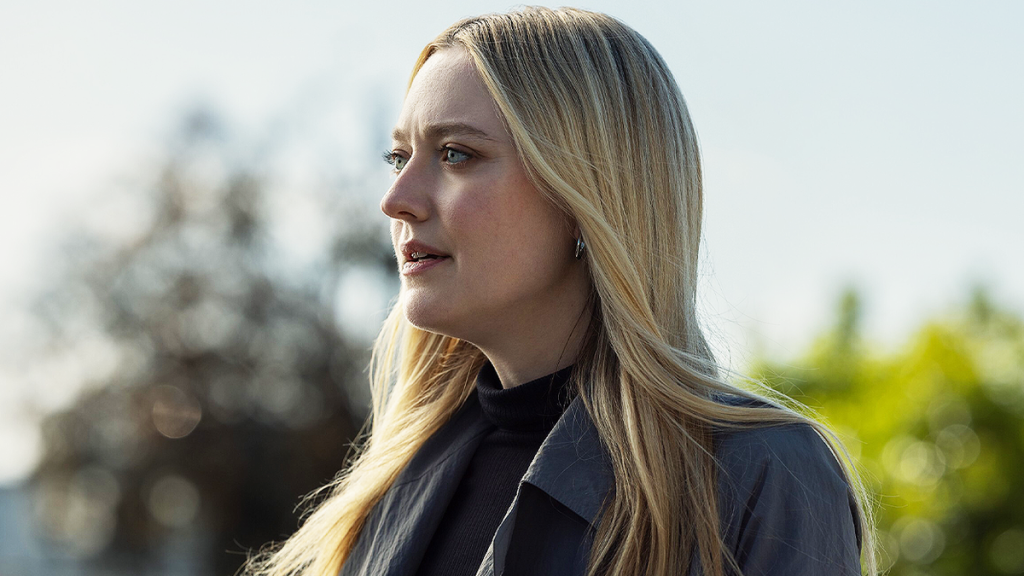
The supporting players each introduce new layers of suspicion: Peter (Jake Lacy), Marissa’s composed yet controlling husband; Lia (Abby Elliott), his mercurial sister; Brian (Daniel Monks), the younger brother he financially supports; Ana (Kartiah Vergara), the Irvines’ nanny who happens to be out of town; and Jenny Kaminski (Dakota Fanning), the fellow school mom who becomes Marissa’s lifeline. Everyone has secrets. Everyone has a motive. And no one seems remarkably stable.
Sarah Snook Delivers a Tour de Force Performance

If Succession showcased Snook’s razor-sharp cool, All Her Fault gives her the opposite: A woman unraveling in real time. Marissa is not Shiv Roy with a toddler — she’s defined, almost entirely, by her motherhood, something the series weaponizes at every turn. Snook maps Marissa’s panic, guilt, and growing instability with startling precision, grounding even the series’ wildest twists.
Her dynamic with Fanning becomes one of the show’s strongest threads. Jenny and Marissa bond quickly — too quickly, some might argue — in ways that feel instantly recognizable to working mothers who’ve learned to triage their emotions on instinct. Their closeness raises eyebrows from husbands and police officers alike, but the show understands that women often build alliances in crises that defy logic from the outside. Their friendship becomes one of the series’ most unexpectedly affecting relationships, even as suspicion hangs over every gesture. Michael Peña also plays a crucial role as Detective Alcaras, whose moral compass gets increasingly warped as the case widens. Rather than settling for a stock investigator, the show gives him a complicated home life, a strained relationship with his son, and a growing awareness that the “right” thing and the legal thing aren’t always aligned.
The Finale of ‘All Her Fault’ Goes for Broke

More than anything, All Her Fault sticks because it commits fully to its twists. When the truth behind Milo’s disappearance finally comes into focus, it reframes the entire series — and reshapes every character you thought you understood. Without spoiling the specifics for newcomers, the finale dives into biological truth versus emotional truth, whether justice is possible when systems fail, and the terrifying ways seemingly good decisions can metastasize into violence.
The show’s boldest swing arrives in its final minutes, handing Snook a morally thorny ending that fans will debate long after the credits roll. It’s one of the rare streaming finales that not only answers its central mystery but deepens the story’s thematic core: what mothers owe their children, what they owe themselves, and who gets to decide where guilt belongs.
Though billed as a limited series — and fully adapting Mara’s novel — All Her Fault arrives so fully realized that a second season feels unnecessary. Still, if viewership keeps climbing, Peacock may be tempted to revisit this world. But as it stands, the series is strongest as a self-contained spiral.




Comments
Advertisement