
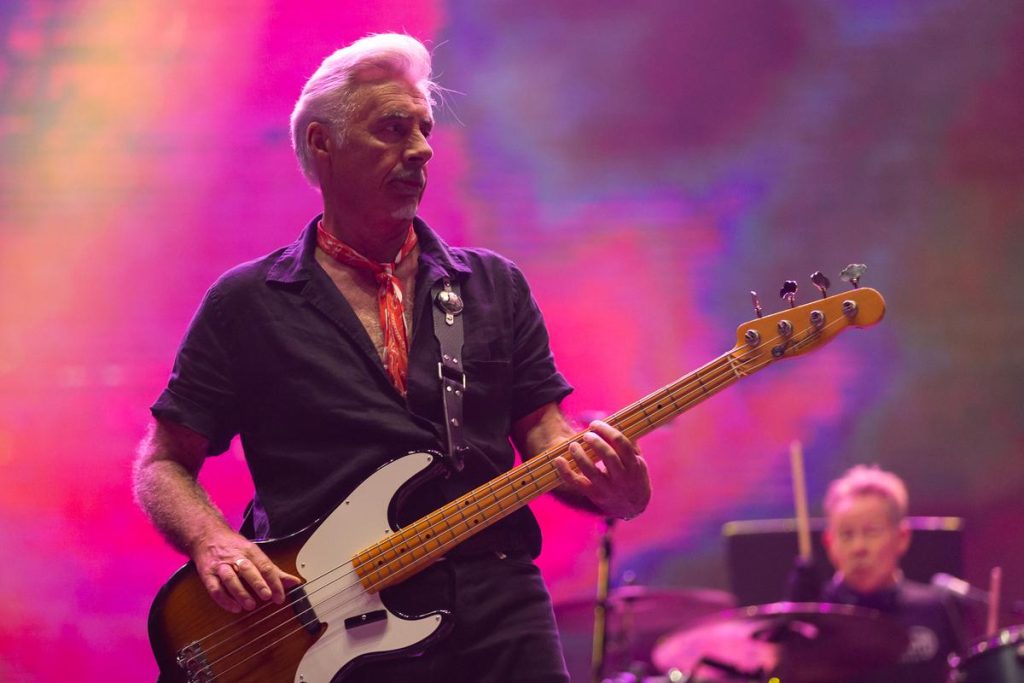
For his entire life, Glen Matlock has been associated with the Sex Pistols.
But as the engaging documentary I Was a Teenage Sex Pistol reveals, the legendary bassist has had many careers, including time spent with a reunited version of the Faces (his musical heroes) and also, a productive and prolific series of solo releases. His story, as many know, goes far beyond the short-lived ’70s group that helped to launch many future generations of bands with the groundbreaking chapters they logged as part of the growing punk movement of the time.
During a recent conversation with UCR, Matlock talked about his experience working on the film, which you can now see on Apple TV. He also digs into his history with the punk legends and why he’s feeling really fulfilled by their current rebirth, working with vocalist Frank Carter.
You can listen to our entire discussion with Glen on all podcast platforms and excerpts from the interview follow below.
I enjoyed this new film and previously, I’d liked your book a lot. What was the experience of turning it into a movie?
They had to to pin me down. When I’d written a book years ago and thought that it was possibly a slightly different take on the same old tale that keeps coming out all the time and was my side of the story a bit more, [that was one thing]. But when you’re actually having something filmed about you, it’s a bit weird, you know? And they kept sending me edits and all that.
I kept putting off watching it because it’s like watching a horror movie when you’re a kid, on the sofa. I ended up thinking, “Actually, it’s pretty good.” It kind of is what it is, really. I’m pleased with the reaction. It’s been out in England and in Europe a few months back, so I’ve had pretty good positive feedback from it. So that’s encouraging. We had a screening in New York, which I couldn’t go to actually, but I’ve had some good feedback from that as well.
How impactful was it for you to go back to some of those places, location-wise? I would guess it’s been a while since you’ve been to some of those places.
Well, yes or no. You know, people say, “Oh, Glen, you’ve got a good memory about these things.” [But] I never wake up in the morning thinking I used to be in the Sex Pistols. But whenever I’ve made a record or done something else, the Pistols come up and I’ve never been allowed to forget about that. There’s a great interview I saw a while back with Keith Richards, and the bloke was talking to him, at the end, he says, “One more sort of silly question, Keith, how much is a pint of milk?”
And he goes, “Hey, man, I don’t know. I’ve been a rock star in my life.” Well, I haven’t been a rock star all my life, but I’ve been an ex-Sex Pistol all of my life, and I haven’t been allowed to forget it. And sometimes these places that are in the movie, you know, there’s a film crew in town, oh, let’s go down there. Or I go to the guitar store.
You know, the middle of London is quite a small place. It’s a bit like being in the East Village in Manhattan, you know. So you bump into people all the time, that I’m not a stranger to those places. Although, I don’t know if it ended up in the movie originally, but a couple of years back, we started doing a bit of shooting with [director] Nick Mead before Andre Relis got involved.
Watch the ‘I Was a Teenage Sex Pistol’ Official Trailer
We went to Paris, and we tracked down this place in Paris called the Chalet du Lac, where we [the Sex Pistols] played there, for a couple of nights [in September of 1976]. It was their CBGB and there’s a little plaque on the wall. The place was really modern [back then], but now it’s like an old, sort of Victorian-style cafeteria. It was really space age modern when we played there. I walked around the place and thought, ‘Oh, I don’t remember it like that.” The little plaque on the wall said how all these people have played there.
The Sex Pistols played there at the inauguration for the first commission for Philippe Stark, the designer. And I never knew that, but when we went there, I met this friend of Malcolm [McLaren]. Malcolm used to go to Paris over the years in the ’60s, and it was a guy called Jean-Charles de Castelbajac. He was quite a big world fashion designer [at that time]. I think he’d spoken to Malcolm, and he said his mate, Philippe Stark, is doing this thing. What can we do for the inauguration? And that’s how we ended up in Paris. But until you go and do those things [for a documentary like this] you can’t piece together the few little things that were going on.
Listen to Glen Matlock on the ‘UCR Podcast’
I liked hearing you say in the film that you realized at some point that your art was being a songwriter.
I don’t know, I just think you’re as good as the last song that you’re trying to write that you had an idea for this morning and where you get ideas for songs. I made six solo albums over the years [that haven’t] sold that well, but there’s some good stuff on them. What I do remember, I had a great riff and I needed something,, a lyric, kind of a little catchphrase, to sort of back up what I was beginning to think about the lyrics for the song.
And I was cold, so I went to the thermostat in my flat to turn the heating on. But there’s heating and it said, hot water. I thought, “Hot water, right!” and I had a great title for a song. You know, ideas come from anywhere, really. You’ve just got to be receptive to them. I quite like what Picasso said. He said he doesn’t just get good ideas by working, but he finds that he does get ideas when he’s been working, you know? So you’ve just got to put yourself in that frame of mind, somehow, to be receptive to what the universe sends down to you.
The Sex Pistols
Just generally, when did you realize that what you guys were doing with the Sex Pistols was groundbreaking and really making an impression, helping to create a new scene?
Before we’d even played a note, really. He didn’t form us, but we all formed in Malcolm McLaren’s shop, Steve [Jones] is the biggest rogue in West London. Malcolm’s shop was next to Granny Takes a Trip, where the Rolling Stones and the Beatles got their clothes. It’s in the World’s End, which is like the wrong end of the King’s Road in Chelsea, London.
Bryan Ferry would be sort of strolling down the street with Antony Price and there’d be Gary Glitter going out. There was a pub we used to go to [around there] and they were all multimillionaires, or so it seemed. Malcolm thought they were tossers, so we did too. And so before we’d even basically picked up a guitar, we had the right kind of rock and roll attitude, I think.
We came around in a period when things that had been happening, the tail end of glam rock and [David] Bowie had kind of been gone a little bit. Or if they’d had any success, any band in England heads to America, where they can make some proper money. There wasn’t a lot going on [in our opinions], so we thought we’d do it ourselves. But we came through when everybody was kind of looking for something different and we happened to be it.
Watch Glen Matlock’s Memories of Developing ‘Anarchy in the U.K.’
As soon as we stuck our heads [up] and waved our “Oh, this is what we’re doing” flag — it wasn’t even called punk rock then — people sort of rallied around us. We were knocking around at Malcolm’s shop and there were some art students, some fashion people and we had a built-in pretty trendy crowd. Which [were also] people like Billy Idol and Siouxsie from the Banshees, Jamie Reid [and other people].
We played this gig at Chelsea School of Art, even before we had a record deal. Malcolm invited one of his chums down to come and see us as a potential record producer. We forgot to put his name on the guest list, so he didn’t come in, because maybe he was a bit stingy, but it was John Cale. [Matlock chuckles] So John Cale wouldn’t stump up 50 pence, which is about 75 cents, to come and see us. So yeah, it’s funny.
READ MORE: Why Malcolm McLaren Couldn’t Get Glen Matlock Back in Sex Pistols
Glen, I’ve made it this far in life without being banned. The Sex Pistols got banned on the grandest of grand scales. We know what it looked like from our side. What did the fallout for you guys feel like on that side of things?
Well, that was the beginning of the end, I suppose you’re talking about the Bill Grundy [television show], where Steve happened to be a bit more drunk than he would normally have been and swore his head off. We’d already been on the front page of the music papers by then. But that next day he was on the front page of all the kind of more schlocky kind of daily press. It became a whole different thing.
We did that Anarchy tour, which we couldn’t play anywhere. It’s a bit boring, really. Traveling around England, we had to go from gig to gig to turn up and show that we weren’t going to kowtow to their censorship. If we hadn’t have turned out, we probably wouldn’t have got the guarantees for the shows as well.
But we had the Heartbreakers on the bus and the Clash and we were just burning money from our record label advance, but me and John [Lydon] were at loggerheads by that stage, so I didn’t last much longer than that, But all the songs had been written for the album and you know, we’d just turned 20 years old. Sometimes you can’t see the wood for the trees, but that was it, really.
READ MORE: Revisiting Sex Pistols’ Anarchy on the TV
But I think with what you did though, it set kind of an important standard.
Yeah, maybe. It was a certain kind of do-it-yourself ethic. But one thing: we worked hard, you know? We managed to get a rehearsal place right in the middle of Soho, in London, in our Tin Pan Alley, Denmark Street.
Me and Steve lived there and we had a rehearsal place downstairs and we met up every day. You know, normally, in England, if you’re in a band and you’re trying to get it together, you can rehearse once a week, if you’re lucky, in some rehearsal studio you have to hire. You get all set up, start playing and find out that nobody’s got a decent idea.
But we rehearsed every day, with our gear already set up and we only had to wait one day to find out that people didn’t have a decent idea. [Laughs] But then you could always get back together the next day. We worked at it and we had nothing better to do. Well, we chose to have nothing better to do. That’s how the cookie crumbled.
One thing that we did musically….I mean, we all had loads of influences between us. I liked the Small Faces and Paul [Cook] and Steve did too. John hated all of that. He liked Van De Graaf Generator and hippie s–t. But there was some crossover. He liked Can, which I liked — one of the best gigs I ever saw was Can at the Hammersmith Palais, which was a dancehall in about 1973. Captain Beefheart? I like Captain Beefheart. But it’s kind of simple, if you make a fish stew, you can have one bit of fish in it, or you can have [a bunch of different kinds] of fish and it’s very rich.
Musically, we kind of knew what we didn’t want to sound like, but we was going to do it anyway. It just came out with all of these ideas that were in the back of your mind. The other thing, as well, there was a guy who used to knock around with us called Nick Kent, who was like the Lester Bangs of England. He used to write for NME. He was friends with John Cale and gave us a tape of this record and one of the songs on it, we loved it so much. We didn’t have the faintest idea what it was about, it just sounded great. We started playing the song and it was “Roadrunner,” from the Modern Lovers album that didn’t come out for another year. We were in the right place at the right time with the right people.
I like the chapter that you guys have opened with Frank Carter. It seems like you all are having a lot of fun with that.
Yeah, Frank’s great. I hadn’t really thought this through before, but working with him, it was kind of like working with John, [who] did write the most fantastic lyrics. Frank writes lyrics and all, but we haven’t got to that stage with him yet. But it was like we was full of youthful exuberance with John before he got his face in the newspapers, there’s a kind of a bit more of an open honesty. He’s kind of revitalized us, really, you know? I think he’s the right man for the job.
READ MORE: Sex Pistols and Frank Carter 2026 Tour Dates
So it does seem like there’s some desire and drive to see what you guys could do from a writing standpoint with him?
Maybe, but he’s a lot younger than us. I’ve got some ideas, [if] everybody wants to do it, and then you know, there’s [the question of] who owns the name of the Sex Pistols. It’s more complicated than just doing it. Who knows?
Punk Rock’s 40 Best Albums
From the Ramones to Green Day, this is musical aggression at its finest.
Gallery Credit: Michael Gallucci


Comments
Advertisement