
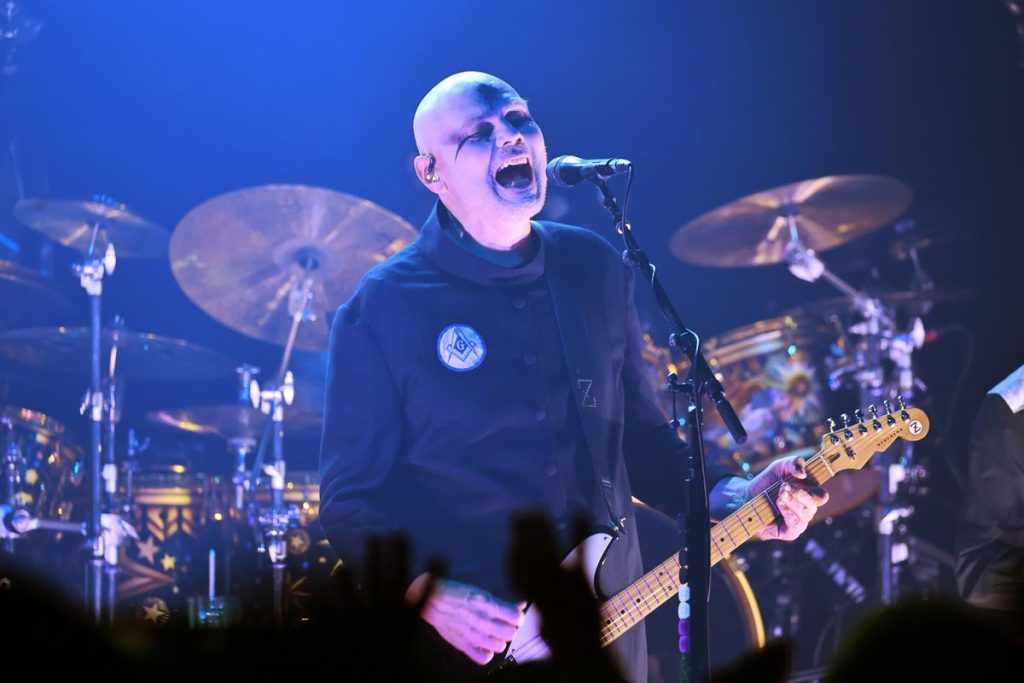
Smashing Pumpkins’ early ’90s output, starting with 1991’s Gish, lit an important fuse and brought a new sound and voice to the alternative landscape. When they released Siamese Dream in 1993, their presence would be further amplified in a big way, thanks to massive amounts of airplay at radio and MTV.
So in 1995, when they shifted from working with Butch Vig to a new collaboration with Alan Moulder and Flood, key architects individually and collectively behind albums by Depeche Mode, Ministry, U2 and many others, fans were interested to hear what that was going to sound like.
They had plenty to digest with the arrival of Mellon Collie and the Infinite Sadness that year. It was a double-LP, which as the band’s mastermind Billy Corgan tells us, nobody wanted. By “nobody,” I guess we should clarify — their record label, Virgin, in his telling, was less than enthused about the idea.
But we know what happened from there. Mellon Collie became their first and only album to top the Billboard 200, powered by multiple hit singles, including “Bullet With Butterfly Wings,” “1979” and of course, the majestic “Tonight, Tonight.”
31 years later, Corgan and Smashing Pumpkins will celebrate with a Mellon Collie-themed tour this fall, featuring two sets. The first, devoted to songs from the album and the second will focus on a variety of material from their four-decade career.
During a conversation with UCR not long after the Rats in a Cage outing was announced, Corgan shared his memories of the time period and what fans can expect from the upcoming concerts.
You announced this tour with a special show and a “funeral requiem” for your character, Zero. How did you decide to say goodbye to Zero?
Well, it kind of fits into the storyline, if anybody follows the long twisted narrative of Zero into Glass into Shiny, now back to Zero. So we were playing with promotional ideas, and somebody brought up the idea of a funeral and I just thought it would be so fun to have kind of a living funeral. I mean, who doesn’t want to kind of have their own funeral? And I have to say, because my wife put a lot of it together, she did a fantastic job. But when I saw her standing up there with Howie Mandel, I thought, “Okay, now we’ve reached peak absurdity.”
How did it feel, the scope of what you did with Mellon Collie and watching how it was received? You guys were already on the rocket ride in one sense, thanks to Siamese Dream and everything before that.
Well, you know, as a student of rock history, I understood that we had achieved something that was very rare to do. Which is, you made this kind of record that shouldn’t be there, but you did,and then it worked. So it felt like a really truly peak moment. It was a peak moment, you know?
We got all the accolades, all these nominations and all these things, but we can never imagine what followed. So it’s weird, because it’s sort of like if the movie stopped there, it would be one thing. But it went in all sorts of crazy directions after that. So it’s always been kind of a bittersweet thing to reflect on, but if I just stay focused on the music and the release and the reception, it was really a magical time.
I was listening to a podcast this morning with folks from KROQ-FM, where they were talking about the Siamese Dream period. Darcy Fulmer, the former music director, was discussing how when the album came out, they were playing “Cherub Rock.” She heard “Disarm” and was like, “That’s the hit, I want to play that.” It’s always been that way, where you can have a plan for your record, but once you put it out into the world, something like that can happen, no matter what the plans are that you have. You can’t predict it. So things like that were a wild thing to be a part of also, right?
Yeah, I mean, even speaking of like Mellon Collie, you know, there was a sort of planned idea for singles, but “Bullet with Butterfly Wings” came out first. I fought it and kind of eventually gave in. It became a big success, and we were pretty sure that “Tonight, Tonight” was going to be the second song. And I remember getting the call, and they said, “It’s got to be ‘1979,’” you know, which was very pop against a song like “Bullet,” which was like a credible huge rock song.
We were like, “You’re crazy, we have this huge double album, you can’t go to the pop single,” and they were like, “We have to.” They put so much pressure on me and then that song was even bigger than “Bullet with Butterfly Wings.” So by the time we got to “Tonight, Tonight,” and that great video by Jonathan [Dayton] and Valerie [Faris], then the thing just seemed to go through the stratosphere when that video kicked in, because that video became kind of the video of that time,
Watch the Smashing Pumpkins’ ‘Tonight, Tonight’ Video
Speaking of “Bullet,” when I hear that song, I wonder what you think, with hindsight, you had learned about writing things that would get on the radio and MTV because of Siamese Dream and anything else you might want to cite?
Well, you know, I wasn’t sure that “Bullet” was going to be a successful radio song. Back then I really didn’t think about it much. I just tried to write the best songs I could. And then after we sorted it all through, we thought, “Okay, these are probably the best singles.” So the entire time I was writing “Bullet,” I wasn’t thinking, “Oh, I’ve got to make this part shorter or longer, because of the radio stations.”
I didn’t think about it at all, and I was convinced “Jellybelly” was going to be the first single off of Mellon Collie, and it never even became a single at all. Of course, we still play it now, every night and when we play it, I mean, it just lights the house on fire. It’s just one of those songs, but it was never a single.
So there’s classic rock and roll, the song I didn’t think was a single became a big hit and the song I thought was a single didn’t become a hit, but we still play the song and people love it. So I can’t complain, because with hindsight, you look at it more like, “Well, did it all kind of work out?” Certainly, with that album, it worked out,
Listen to Billy Corgan on the ‘UCR Podcast’
It sounds like, just generally, you did have an idea that some of this stuff might have potential.
Honestly, I wasn’t so sure, because the sound of Mellon Colie was so different than Siamese, you know. Butch had done an amazing job with Siamese at sort of polishing us up and making us sound more professional than we were. [Working] with Flood, he wanted the raw edges of the band, which I was all for, because that was the band I was in every night on stage.
Flood infamously said, “I want the band on stage on record,” and that’s why Mellon Collie sounds so raw, because it was like, okay, you want that band, we’ll bring it. Because the band was certainly a darker animal on stage than, say, Siamese Dream would have indicated. Butch has a way of sort of finding the sweeter side of our personality, you know. So I wasn’t so sure people were going to take to that.
It was the early, early days of [what became] “social media,” but I remember reading comments around ’96 where people were saying that, you know, we messed up and and we should have stuck with the Siamese Dream sound. And still to this day, there are people who really wish we’d just stayed as that band, that sort of sweeter, more fuzzy band, but it wasn’t true to who we were. It was part of who we were, but it wasn’t certainly true to who we were.
Watch the Smashing Pumpkins’ ‘Bullet With Butterfly Wings’ Video
Even as sure as you might have been of yourself and what the band was up to in that era, it still seems like it could have been daunting, the idea of, even if your record label was down with it, of putting a double album out in the universe.
Well, they were totally against it. They fought me up and down [and] said no seven times. I mean, seven separate times, like, “No, [we’re] not going to do it. [You’ve] got to release it separately or we’ll release them a year apart.” They were totally against it and I just fought it and fought it and eventually they gave in.
But being told no just makes you want to do it more, right?
Well, I was definitely punkish in that way. But you know, listen, maybe the pressure internally helped me work harder than maybe I would have. I worked so hard on that record. I mean, I worked for eight months straight on that record and when I say eight months straight, I mean eight months straight. It was a lot of work. The one statistic I roll out every once in a while, I think we worked 86 days in a row to finish the record because we were late.
Wow.
Yeah, that was just total insanity. I mean, you talk about psychedelic tripping? You work 86 days in a row in anything and it’s Groundhog Day. Somehow we got it done and the rest is history.
You toured in recent years with your solo band, playing the Mellon Collie songs. You’ve been working on the opera version of Mellon Collie with the Lyric Opera of Chicago that will premiere this year as well. How does all of that inform the show you’re putting together for this upcoming tour? I would guess it all contributes in some interesting ways.
Yeah, the Machines of God tour was what I would call a deep cut tour. We mostly focused on Mellon Collie, I think, and Machina, Some of the Aghori Mhori Mei album. And you know, I’ve been fighting my band for years to do deep cuts tours, like we need to play past the hits. There’s a lot of fans out there that want to hear album stuff.
My band just would not be supportive enough of it to the point where it ever would happen. So I was just like, “I’m just going to go out [and do that].” I put together a band, we had an amazing time and the shows were great. And then the opera showed me, there’s this other side, which is like the music needs to be presented more theatrically and maybe a little bit more dramatically than just a rock concert, like turn it up and hit it hard.
So I think this tour will bear the influences of both tours, there’ll be greater deep cut influence over, especially with the second set, but also in the Mellon Collie set. But additionally, I want to find a more theatrical and more sort of dramatic way to present, because I think we need to be challenged at this point. I mean, we’re a great rock and roll band and I’m proud to say that it’s been a hard-earned thing, but I think challenging ourselves to then bring something new to the fans after all these years is really our responsibility to the fans.
READ MORE: Smashing Pumpkins Announce ‘Mellon Collie’ 30th Anniversary Tour
Top 100 ’90s Rock Albums
Any discussion of the Top 100 ’90s Rock Albums will have to include some grunge, and this one is no different.
Gallery Credit: UCR Staff
Comments
Advertisement